
Assistive Technology
The Success of a Power Assist Wheelchair Trial: How the Right Technology Can Improve Independence
For individuals who rely on a manual wheelchair, everyday mobility can involve considerably more physical effort than many people realise.
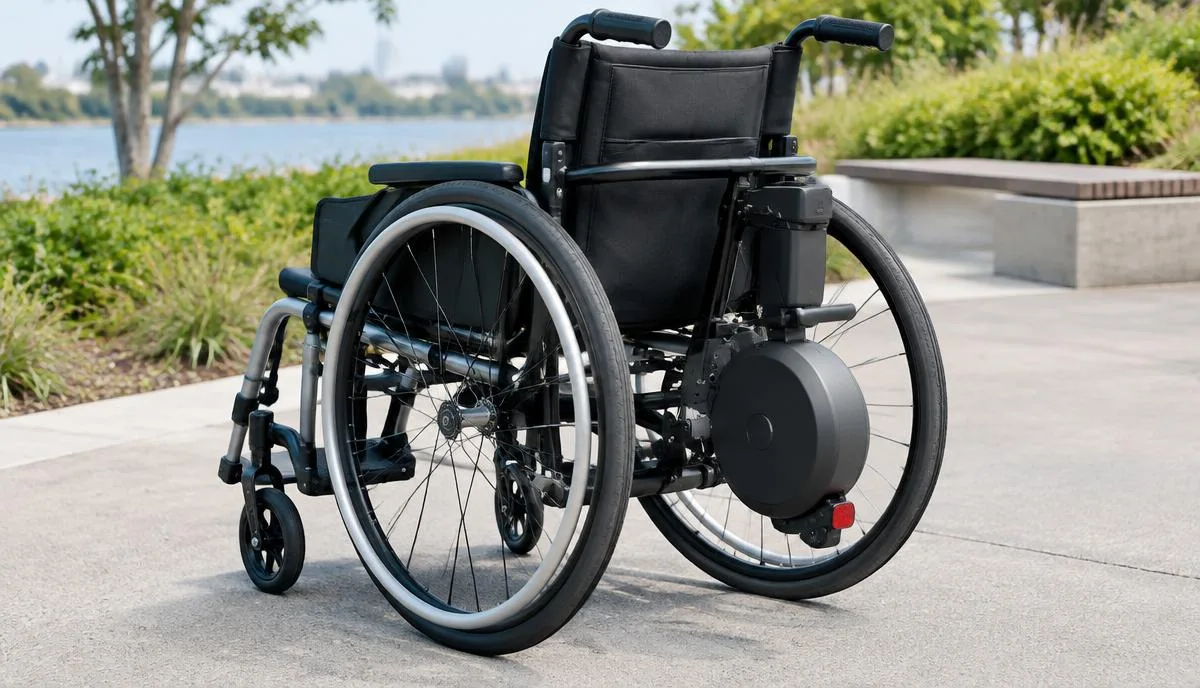
A Small Addition to a Wheelchair Can Make a Big Difference: The Success of a Power Assist Trial
For individuals who rely on a manual wheelchair, everyday mobility can involve considerably more physical effort than many people realise.
Navigating shopping centres, uneven footpaths, sloping pathways, longer distances and community environments can place significant demands on the shoulders, arms and hands.
While manual wheelchairs provide an important means of independent mobility, the physical effort required to propel them can sometimes limit participation in meaningful everyday activities.
At Today & Tomorrow Allied Health Services, our approach to assistive technology assessment focuses on identifying equipment that supports a person’s independence while preserving their existing abilities.
Power assist technology is one example of how a relatively small modification to an existing wheelchair can potentially produce substantial functional benefits.
What Is Wheelchair Power Assist Technology?
Wheelchair power assist technology provides powered assistance to a manual wheelchair, reducing the physical effort required for propulsion.
Unlike a conventional powered wheelchair, many power assist systems allow a participant to continue using their existing manual wheelchair.
Different systems include push-rim activated power assist wheels, rear-mounted powered attachments and attendant-controlled systems.
Push-rim activated systems respond to the user’s propulsion effort, providing additional assistance with each push.
Rear-mounted systems provide powered propulsion through a separate attachment and control interface.
Attendant-controlled systems can reduce the physical demands placed on support workers or family members assisting with wheelchair mobility.
The suitability of each system depends on the participant’s physical capacity, functional goals, wheelchair configuration and intended environments.
Why Power Assist Technology Can Be Beneficial
For individuals who experience reduced upper limb strength, pain, fatigue or limited endurance, manually propelling a wheelchair can restrict community participation.
A person might independently navigate their home but experience considerable difficulty accessing local shops, medical appointments or recreational activities.
Power assist technology can reduce propulsion demands and allow the individual to conserve energy for other meaningful activities.
Potential benefits include improved mobility endurance, reduced repetitive loading through the upper limbs, greater access to community environments and reduced reliance on another person for propulsion.
However, these benefits must be demonstrated through an appropriate assessment rather than assumed.
Why an Equipment Trial Is Essential
A power assist system that performs well in a showroom will not necessarily perform equally well in the participant’s everyday environments.
An occupational therapy trial should consider the participant’s mobility needs, upper limb function, postural control, ability to operate the controls and capacity to navigate environmental obstacles.
The trial should also examine braking, turning, transport requirements, wheelchair compatibility and safety.
Where possible, the equipment should be assessed across environments representative of its intended use.
This can include indoor spaces, footpaths, ramps and other community environments.
What Makes a Power Assist Trial Successful?
A successful power assist trial is one that demonstrates meaningful improvements in function, safety or participation.
The outcome is not simply whether the equipment works.
The important question is whether the technology allows the participant to complete activities more independently, efficiently or safely.
For example, a trial may demonstrate that a participant can travel greater distances with reduced physical effort, navigate challenging environments more effectively or participate in community activities with less assistance.
The occupational therapist should document the participant’s performance with and without the equipment wherever appropriate.
Relevant outcomes can include propulsion effort, fatigue, endurance, safety, control access and functional independence.
Supporting Long-Term Upper Limb Function
Long-term manual wheelchair propulsion places repetitive demands on the shoulders, elbows, wrists and hands.
For some wheelchair users, this can contribute to pain and reduced endurance over time.
Power assist technology may reduce repetitive propulsion demands, particularly across longer distances or challenging terrain.
However, the equipment must be appropriately configured and used.
The potential benefits should be considered alongside factors such as device weight, maintenance, transport compatibility and the participant’s ability to safely operate the system.
NDIS Funding and Clinical Justification
Where power assist technology is being considered through the NDIS, the clinical justification should explain why the equipment is required to address disability-related functional limitations.
The report should connect the proposed equipment to the participant’s everyday activities, goals and identified support needs.
It should also consider alternative equipment options, value for money and the anticipated functional benefits.
A recommendation should demonstrate why the proposed device is an appropriate solution rather than simply describing its features.
Funding remains subject to the participant’s plan and applicable NDIS requirements.
The Right Equipment Can Change Everyday Participation
Assistive technology is most effective when it is selected around the person rather than expecting the person to adapt to unsuitable equipment.
At Today & Tomorrow Allied Health Services, wheelchair and power assist assessments consider the individual’s functional capacity, environment, daily routines and long-term mobility needs.
Our focus is on supporting meaningful independence through carefully selected and clinically justified equipment.
Considering a Power Assist Wheelchair Trial?
Today & Tomorrow Allied Health Services provides occupational therapy assessments for wheelchairs, power assist systems and other assistive technology.
Learn more about our assistive technology services:
Or submit an assessment referral:
Equipment examples
Examples of different equipment designs, not individual recommendations or endorsements. Suitability, seating, controls and compatibility need to be assessed and trialled. Pressure-redistributing seating does not remove the need for an individual pressure-care plan.
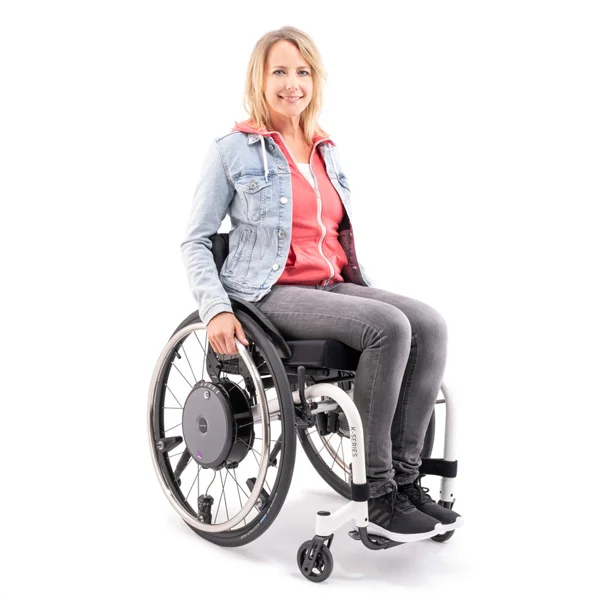
Powered push-rim wheels — Alber e-motion M25
Motors within the wheel hubs add assistance to each push. The user still steers using the push-rims; this differs from joystick-controlled driving.
Photo and product details: Push Mobility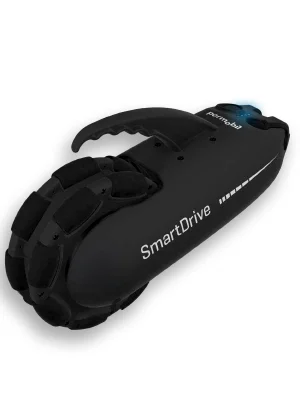
Rear-mounted powered drive — SmartDrive MX2+
A separate drive unit mounts behind a compatible manual wheelchair to provide propulsion. The user steers the wheelchair; the control interface and safe stopping need to be trialled.
Photo and product details: Permobil Australia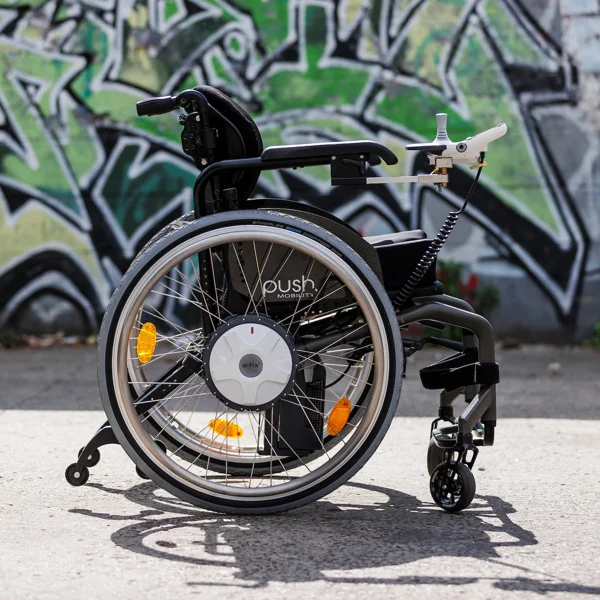
Joystick-controlled add-on drive — Alber e-fix E35
Powered wheels and a joystick convert a compatible manual chair to powered driving. Unlike push-rim assistance, the joystick controls direction and speed; seating, access and wheelchair compatibility still require assessment.
Photo and product details: Push MobilityOfficial sources
This article provides general information only. NDIS rules and individual circumstances can change; check current official guidance or seek advice about your situation.