
Clinical insights
Manual, Power Assist or Power Wheelchair? Understanding Your Mobility Options
Manual, power assist and power wheelchairs each suit different strengths, environments and goals. The right choice starts with how a person wants and needs to live.
Key points
- Manual, power assist and power wheelchairs each suit different strengths, environments and goals.
- The right choice starts with how a person wants and needs to live.
Choosing a wheelchair isn’t simply a matter of deciding between manual and powered mobility.
The right mobility device depends on a person’s strength, endurance, posture, environment, functional ability, lifestyle, transport arrangements and what they actually want to be able to do.
Three commonly considered options are manual wheelchairs, power-assist systems and power wheelchairs.
Manual wheelchairs
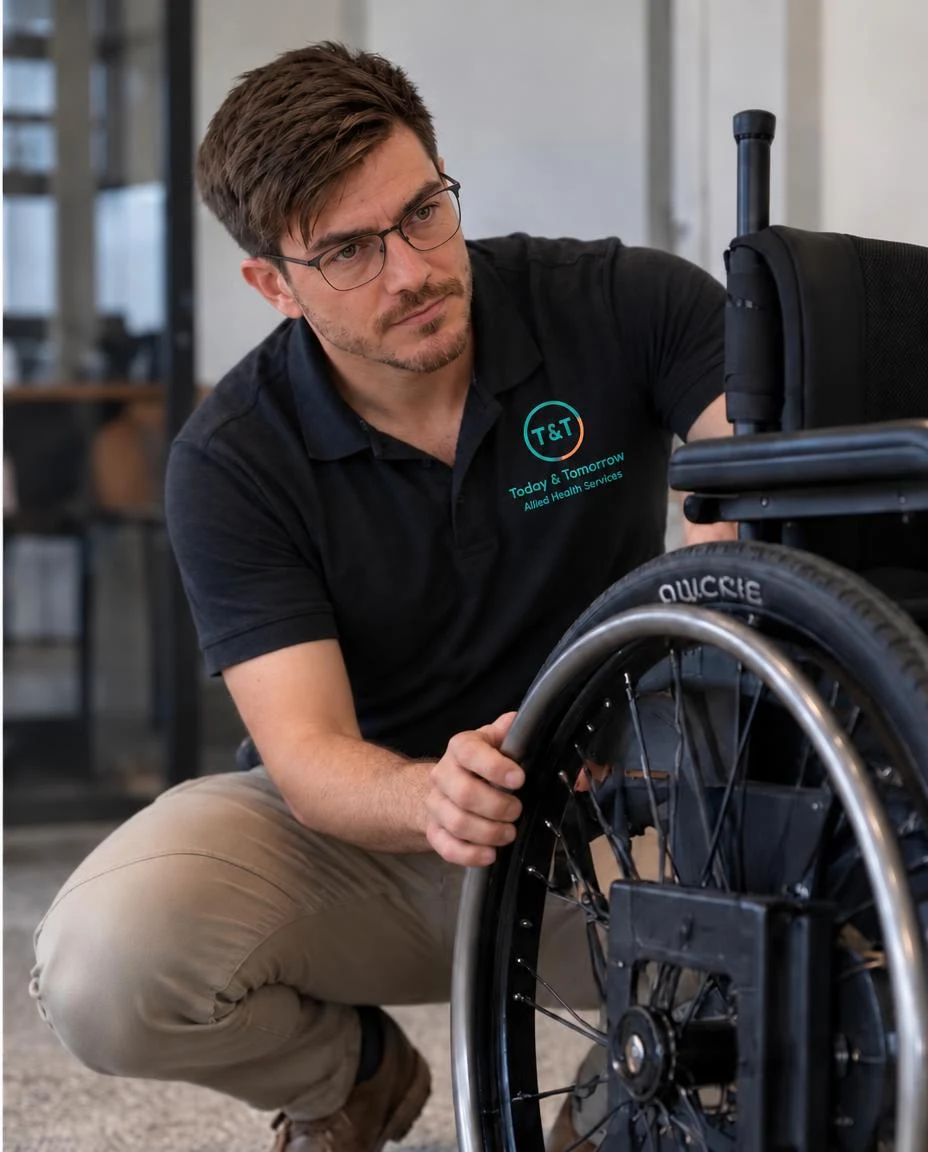
Manual wheelchairs are propelled by the user through the push rims or by another person using attendant handles.
For people who can independently propel, a correctly configured manual wheelchair can provide an efficient and highly manoeuvrable form of mobility. Manual wheelchairs can also be relatively lightweight and easier to transport than powered alternatives, particularly where a wheelchair can be folded or disassembled.
However, independent manual propulsion requires sufficient upper-limb function and endurance. Poor wheelchair configuration or repetitive propulsion can also increase physical demand on the upper limbs.
Wheelchair prescription therefore needs to consider much more than seat width. Rear wheel position, seat height, centre of gravity, seating configuration and overall chair geometry can significantly influence how the wheelchair performs.
Power assist
Power-assist technology sits somewhere between conventional manual and fully powered mobility. It adds powered assistance to a manual wheelchair, reducing the physical effort required to propel the chair.
Different systems operate differently. Some provide powered assistance through the wheelchair wheels, while others use an additional powered drive unit.
Power assist can be particularly useful for people who want to retain the benefits of a manual wheelchair while reducing the effort associated with longer distances, hills or demanding environments. It may also reduce the amount of repetitive propulsion required throughout the day.
Power wheelchairs
Power wheelchairs use electric motors and batteries to provide mobility and are generally controlled using a joystick or another specialised control system.
They can provide independent mobility for people who cannot efficiently use a manual wheelchair or whose mobility requirements cannot adequately be met through manual propulsion. They can also accommodate sophisticated seating systems and powered functions such as tilt, recline and seat elevation where clinically required.
However, not all power wheelchairs handle the same way. One of the biggest differences is the location of the drive wheels.
Front-wheel drive
In a front-wheel-drive power wheelchair, the large drive wheels are positioned towards the front. Because these wheels encounter an obstacle early, these chairs can provide useful performance across certain thresholds and uneven surfaces. They can also perform well outdoors and provide good directional stability once moving.
The trade-off is that much of the wheelchair sits behind the drive wheels. When turning, the rear swings outward. This tail swing needs to be considered around furniture, doorways and other people.
- Strong outdoor performance
- Useful obstacle and threshold negotiation
- Good forward stability
- Drive wheels approach obstacles first
Rear-wheel drive
Rear-wheel-drive power wheelchairs have their main drive wheels towards the rear. Their handling can feel relatively intuitive, particularly when travelling forward at speed. They generally provide strong directional stability and can perform well across longer distances and outdoor environments.
Because the chair pivots from further towards the rear, more space can be required for tight turns. This may make rear-wheel drive less suitable in homes with narrow hallways or confined spaces.
- Predictable forward handling
- Good directional stability
- Strong performance over longer distances
- Often well suited to outdoor mobility
Mid-wheel drive
Mid-wheel-drive power wheelchairs position the main drive wheels close to the centre of the user. This allows the wheelchair to rotate around a point close to the person, producing a small turning circle.
That can make mid-wheel drive particularly effective indoors, where manoeuvring through doorways, around furniture and within confined spaces is important. Modern models can also provide excellent outdoor performance, although suspension, obstacle negotiation and terrain capability differ considerably.
- Excellent indoor manoeuvrability
- Small turning circle
- Responsive steering
- Easier positioning within confined environments
So which drive type is best?
There isn’t one drive configuration that is universally better.
A person living in a compact apartment may prioritise turning radius and indoor manoeuvrability. Someone regularly travelling longer distances outdoors may prioritise different handling characteristics. Another person may need to negotiate ramps, thresholds, uneven surfaces or challenging community environments.
This is why wheelchair prescription should involve assessment and, wherever possible, equipment trials in environments that reflect how the wheelchair will actually be used.
More than just mobility
A wheelchair is not simply a way of getting from one location to another. For someone who uses it throughout the day, it can influence their ability to work, study, socialise, access the community, complete personal activities and participate in family life.
The seating system is equally important. Postural support, pressure management, comfort, functional reach, transfers and access to controls all need to be considered alongside the wheelchair base itself.
Occupational therapy and wheelchair prescription
Occupational therapists can assess functional mobility, physical abilities, environmental requirements, daily activities, transport needs and seating requirements to help determine which mobility options should be explored.
For NDIS participants, this can also involve assistive technology assessment, equipment trials, liaison with suppliers and clinical justification for the recommended equipment.
At Today & Tomorrow Allied Health Services, the focus is not simply on finding a wheelchair that a participant can use. The goal is to identify mobility technology that supports how they want and need to live — at home, in the community and wherever life takes them.
Separate mobility choice from funding approval
An equipment recommendation requires individual assessment and suitable trials; this overview cannot prescribe a wheelchair or guarantee NDIS funding. Ask about the equipment-assessment scope rather than assuming a general FCA includes every trial, quote or prescription task.
References and further reading
This article provides general information only. NDIS rules and individual circumstances can change; check current official guidance or seek advice about your situation.
Need an assessment or ongoing occupational therapy?
We respond to every referral within two business days, with mobile visits across South East Queensland and the Northern Rivers and Telehealth Australia-wide.