
Clinical insights
Rural NDIS Functional Capacity Assessments and Assistive Technology: What You Need to Know
Rural Functional Capacity Assessments must consider more than a diagnosis — gravel driveways, limited local services and equipment servicing all shape clinically justified recommendations.
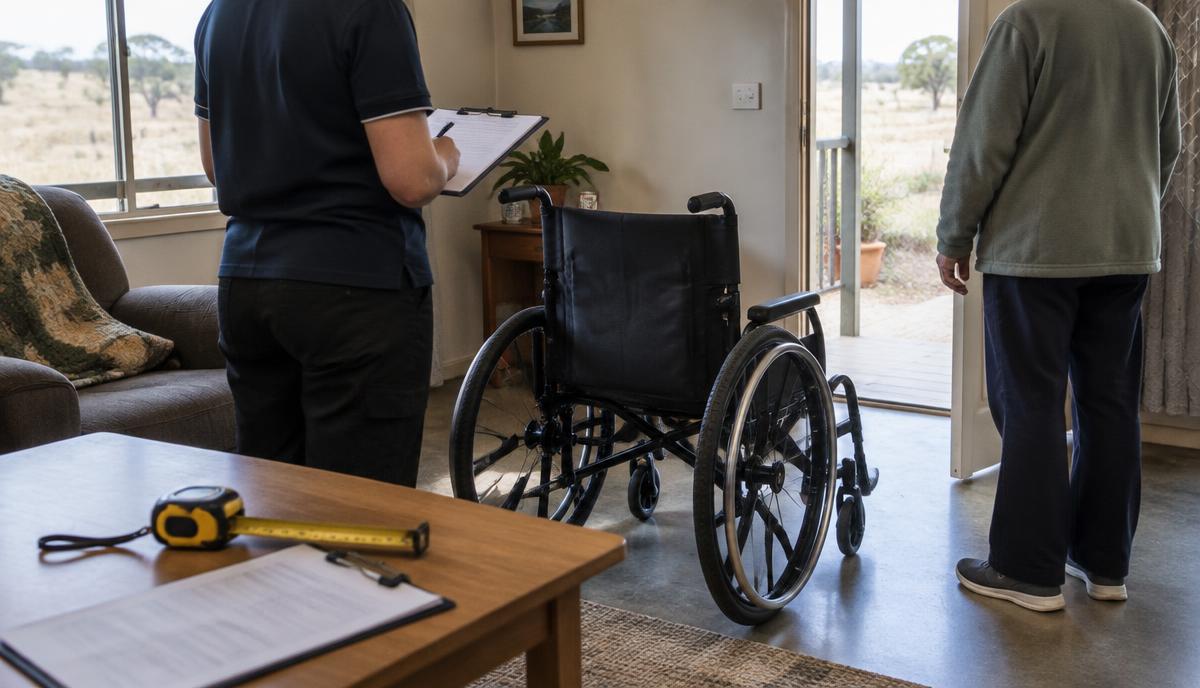
Accessing Occupational Therapy Assessments in Rural and Remote Australia
Accessing an Occupational Therapist in rural or remote Australia can be challenging, particularly when a participant requires a comprehensive NDIS Functional Capacity Assessment (FCA) or assistive technology assessment.
Limited local providers, long travel distances, equipment supplier availability and environmental accessibility can all affect how assessments are completed and recommendations are implemented.
For NDIS participants living in regional and remote communities, an effective Occupational Therapy assessment must consider more than a diagnosis or an individual’s performance during a single appointment.
It must examine how disability affects everyday activities, how the home environment influences functional performance and whether recommended supports can be practically implemented.
Understanding these factors is essential when preparing clinically justified NDIS recommendations.
What Is an NDIS Functional Capacity Assessment?
An NDIS Functional Capacity Assessment is an Occupational Therapy assessment that examines how a participant’s disability affects their ability to complete everyday activities and participate in meaningful occupations.
Depending on the individual’s circumstances, an FCA may examine:
The assessment may involve clinical interviews, functional observations, standardised assessment tools, review of existing documentation and consultation with relevant support networks.
Findings can inform recommendations for disability-related supports, therapy, assistive technology and other appropriate interventions.
- Personal care and daily living activities.
- Mobility and transfers.
- Domestic activities and household management.
- Communication and social participation.
- Cognitive functioning and executive skills.
- Community access and transport.
- Self-management and decision-making.
- Existing formal and informal supports.
Why Are Rural Functional Capacity Assessments Different?
Participants living in rural areas may face additional environmental and service access challenges.
For example, a participant living on a rural property may need to negotiate gravel paths, uneven ground, external stairs or significant distances between buildings.
These environmental demands may increase the functional impact of an existing mobility impairment.
Similarly, someone with cognitive or executive functioning difficulties may experience additional challenges when grocery shopping, accessing appointments or coordinating services requires extensive planning and travel.
An Occupational Therapist should distinguish between the impact of disability and the broader challenges associated with geographical isolation.
However, it is equally important to understand how these factors interact in the participant’s everyday life.
1. Assess Functional Capacity in the Participant’s Actual Environment
A participant’s ability to complete a task in a clinic may not accurately represent their ability to perform the same activity at home.
For example, walking safely on a level indoor surface does not necessarily mean someone can safely navigate a gravel driveway or uneven pathway.
Rural home assessments should consider internal and external access, gradients, surface conditions, lighting, bathroom accessibility, transfer arrangements and access to essential areas of the property.
Environmental assessment is particularly important when considering mobility equipment, home modifications or physical assistance requirements.
Where direct observation is necessary, an in-person assessment should be arranged.
2. Consider the Availability of Disability Support Workers
Some rural communities have limited access to disability support workers and allied health professionals.
This can affect the consistency and reliability of support arrangements.
A participant who requires assistance with personal care, transfers or meal preparation may experience significant risk if essential support is unavailable.
An FCA should examine the participant’s actual support requirements, the sustainability of informal care and the consequences of interrupted formal supports.
Recommendations should identify disability-related support needs and explain the level, frequency and type of assistance required.
Geographical isolation should be considered when planning implementation, but it does not independently establish eligibility for additional NDIS funding.
3. Choose Assistive Technology That Works in Rural Environments
Assistive technology must be appropriate for the participant, their functional needs and the environment in which the equipment will be used.
This is particularly important for powered mobility equipment.
For example, a powered wheelchair that performs well on smooth indoor flooring may not be suitable for a rural property with loose gravel, uneven pathways or steep gradients.
When prescribing assistive technology, Occupational Therapists should consider:
The aim is to recommend equipment that is clinically appropriate, practical and sustainable.
- Mobility requirements and functional limitations.
- Terrain and environmental accessibility.
- Equipment dimensions and manoeuvrability.
- Battery capacity and charging arrangements.
- Transport and storage requirements.
- Maintenance and servicing availability.
- Participant and support worker training.
- Safety risks associated with equipment use.
4. Plan Wheelchair and Mobility Equipment Trials Carefully
Wheelchair assessments can be more complex when participants live several hours from the nearest assistive technology supplier.
Transporting equipment to rural locations may require additional coordination.
Where possible, trials should be completed in an environment representative of the participant’s intended use.
For a participant requiring a powered wheelchair or power-assist device, this may include assessing manoeuvrability, seating, postural support, functional access and performance on relevant surfaces.
Equipment selection should also consider whether the participant can safely operate, transport and maintain the device.
A successful showroom trial does not automatically establish suitability for everyday rural use.
5. Consider Equipment Repairs and Servicing
Assistive technology prescription does not end when equipment is delivered.
Maintenance, repairs and replacement parts are important considerations, particularly in remote communities.
For participants dependent on a wheelchair, hoist or specialised bed, equipment failure can significantly affect independence and safety.
Occupational Therapists should consider whether suitable repair services are available locally, whether equipment can be serviced within a reasonable timeframe and what contingency arrangements are required.
Where clinically justified, backup arrangements should be documented.
6. Assess Home Modification Requirements
Rural properties may include older buildings, non-standard layouts and challenging external access conditions.
Common disability-related home modification considerations include accessible bathrooms, ramps, doorway widening, handrails and changes to internal circulation areas.
The Occupational Therapist must assess the participant’s functional requirements and the intended benefits of the modification.
Depending on complexity, input from builders, building designers or other relevant professionals may also be required.
The proposed modification must be appropriate for the participant and consistent with applicable NDIS funding requirements.
7. Use Telehealth to Improve Rural Assessment Access
Telehealth Occupational Therapy can improve access for participants who would otherwise need to travel considerable distances.
Depending on clinical suitability, telehealth may support interviews, functional assessment, consultation with support networks, review of existing evidence and follow-up appointments.
A hybrid assessment model may involve preliminary telehealth consultation followed by an in-person visit where environmental assessment or equipment trials are required.
This approach can reduce unnecessary travel while preserving the quality of clinical decision-making.
8. Ensure NDIS Recommendations Are Clearly Justified
When recommending disability-related supports, the Occupational Therapist should explain the clinical reasoning behind each recommendation.
A comprehensive report should identify the participant’s functional impairment, relevant risks, proposed support, expected functional benefits and how the recommendation addresses disability-related needs.
For assistive technology, this may also involve equipment specifications, trial findings, quotations and consideration of suitable alternatives.
Strong clinical evidence can help the NDIA understand why a support is being requested.
However, recommendations must still satisfy the relevant NDIS funding criteria.
How Can Rural Participants Access an Occupational Therapist?
Participants and support coordinators can enquire about outreach availability, telehealth suitability and the assessment requirements before arranging an appointment.
Providing relevant reports, details of the participant’s location and the purpose of the assessment can help determine the most appropriate service delivery approach.
Rural and Regional Occupational Therapy With Today & Tomorrow Allied Health Services
Today & Tomorrow Allied Health Services provides NDIS Occupational Therapy assessments through flexible service delivery arrangements.
Our assessment services include:
We understand that geographical location can create barriers to accessing timely clinical assessments.
Our approach focuses on understanding the participant’s functional needs, living environment and practical support requirements.
Need a rural NDIS Functional Capacity Assessment or assistive technology assessment?
Contact Today & Tomorrow Allied Health Services to discuss assessment availability and referral options.
- Functional Capacity Assessments.
- Assistive technology assessments and prescription.
- Wheelchair and mobility assessments.
- Supported Independent Living assessments.
- Specialist Disability Accommodation assessments.
- Rural outreach and Australia-wide telehealth.
Frequently Asked Questions
Can an NDIS Functional Capacity Assessment be completed by telehealth?
Yes. Some Functional Capacity Assessments can be completed through telehealth where the clinician can obtain sufficient reliable information. An in-person assessment may still be necessary for specific functional observations or environmental assessments.
Can an Occupational Therapist prescribe a wheelchair for someone living rurally?
Yes. An Occupational Therapist with appropriate expertise can assess wheelchair requirements and recommend suitable equipment. The assessment should consider the participant’s physical needs, intended environment and safe equipment use.
Does the NDIS fund assistive technology for rural participants?
Eligible participants may receive NDIS funding for disability-related assistive technology where the support meets applicable funding requirements. Living rurally does not automatically establish eligibility, but the environment can be relevant to equipment selection.
What should a rural Functional Capacity Assessment include?
An FCA should assess relevant areas of everyday functioning, identify disability-related limitations and provide clinically justified recommendations. The assessment should consider the participant’s actual living environment and available supports.
Can a support coordinator refer someone for a rural OT assessment?
Yes. Support coordinators can assist participants to identify and contact suitable Occupational Therapy providers, subject to the participant’s preferences, consent and funding arrangements.
Need a Functional Capacity or Assistive Technology Assessment?
Contact Today & Tomorrow Allied Health Services to discuss assessment availability, rural outreach and Telehealth options. Support coordinators, families and participants can send a referral online in a few minutes.
Official sources
This article provides general information only. NDIS rules and individual circumstances can change; check current official guidance or seek advice about your situation.